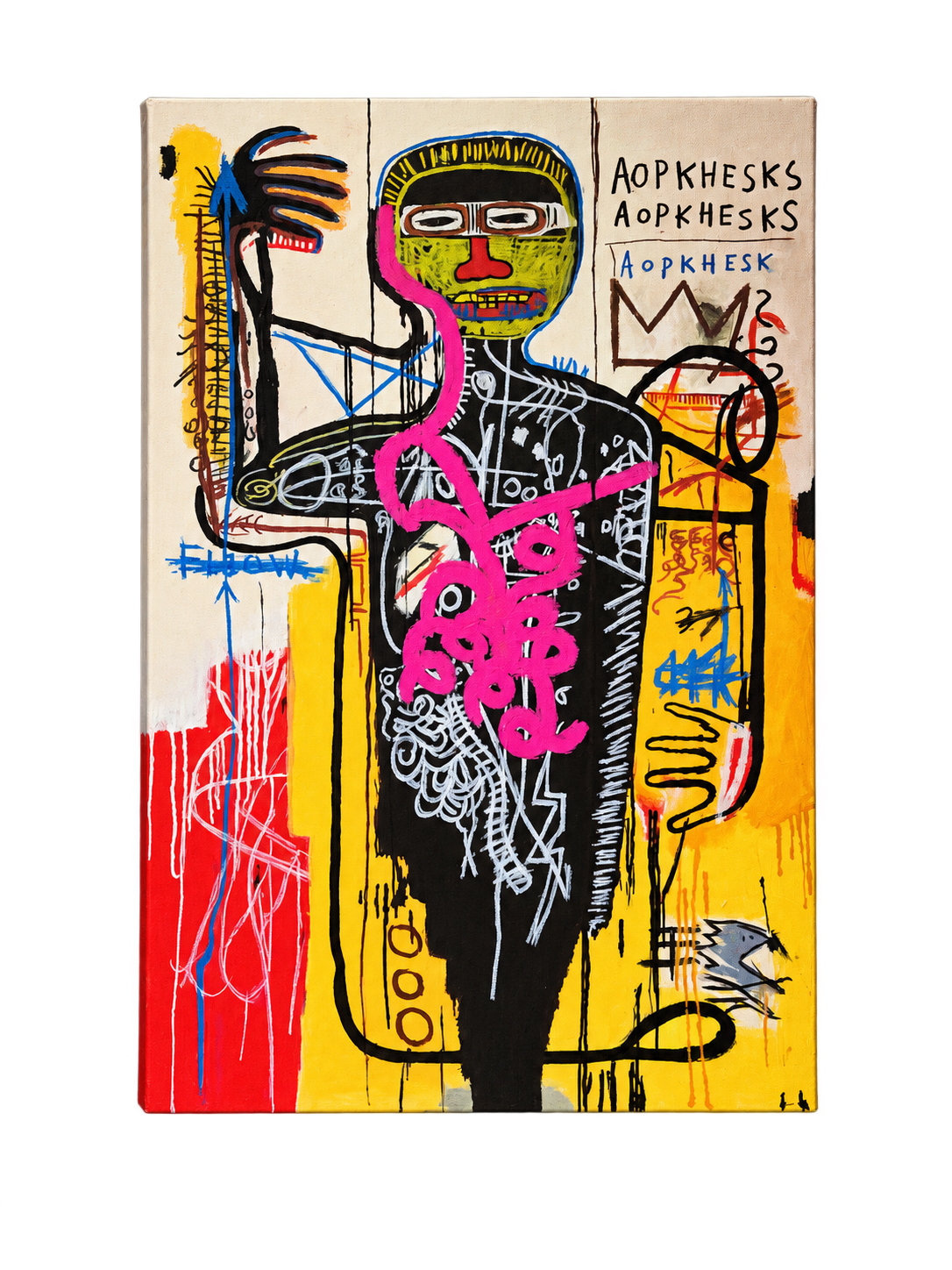
A reading of the work
The upright figure takes the place of the hero. White anatomical lines leave the torso exposed, while the crown gives the figure an elevated rank. A pink gesture crosses the yellow field and seems to reach towards the viewer. It can be read as an assertion of dignity that keeps the body’s vulnerability visible. That vulnerability makes the figure’s resolve seem like an effort, still subject to the gaze of others.
In Sotheby’s reading, Basquiat claims a place among the Renaissance masters and challenges the power of patrons. The structure of the original, three joined canvases, recalls the altarpiece and its religious and political authority.Sotheby’s
The artist and the history of the original
Basquiat was born in Brooklyn in 1960 and entered the New York scene through graffiti and music. Together with Al Diaz, he developed SAMO, a project of phrases written on the walls of Manhattan. In 1980 he took part in the Times Square Show; a year later he exhibited in New York/New Wave at P.S.1 and held his first European solo exhibition in Modena. On canvas, he brought the language of the street into a mixture of writing, figures and anatomy. This practice placed identity and the question of who gains space in art at the centre of his work.The Estate of Jean-Michel Basquiat The Estate of Jean-Michel Basquiat Whitney Museum The Estate of Jean-Michel Basquiat
The original sold at Sotheby’s in New York on 12 May 2021 for US$50,820,000. The auction record states that Stéphane Janssen acquired it in October 1982, following its time at Larry Gagosian Gallery; the selling collection had purchased it in 1990.Sotheby’s Sotheby’s