
Maestros011960—1988

Art history

JEAN-MICHEL BASQUIAT: GENIUS OF THE STREETS AND THE ART MARKET

From the aphorisms of SAMO to major galleries: anatomy, African American history and the violence of a meteoric career.

Read the profile
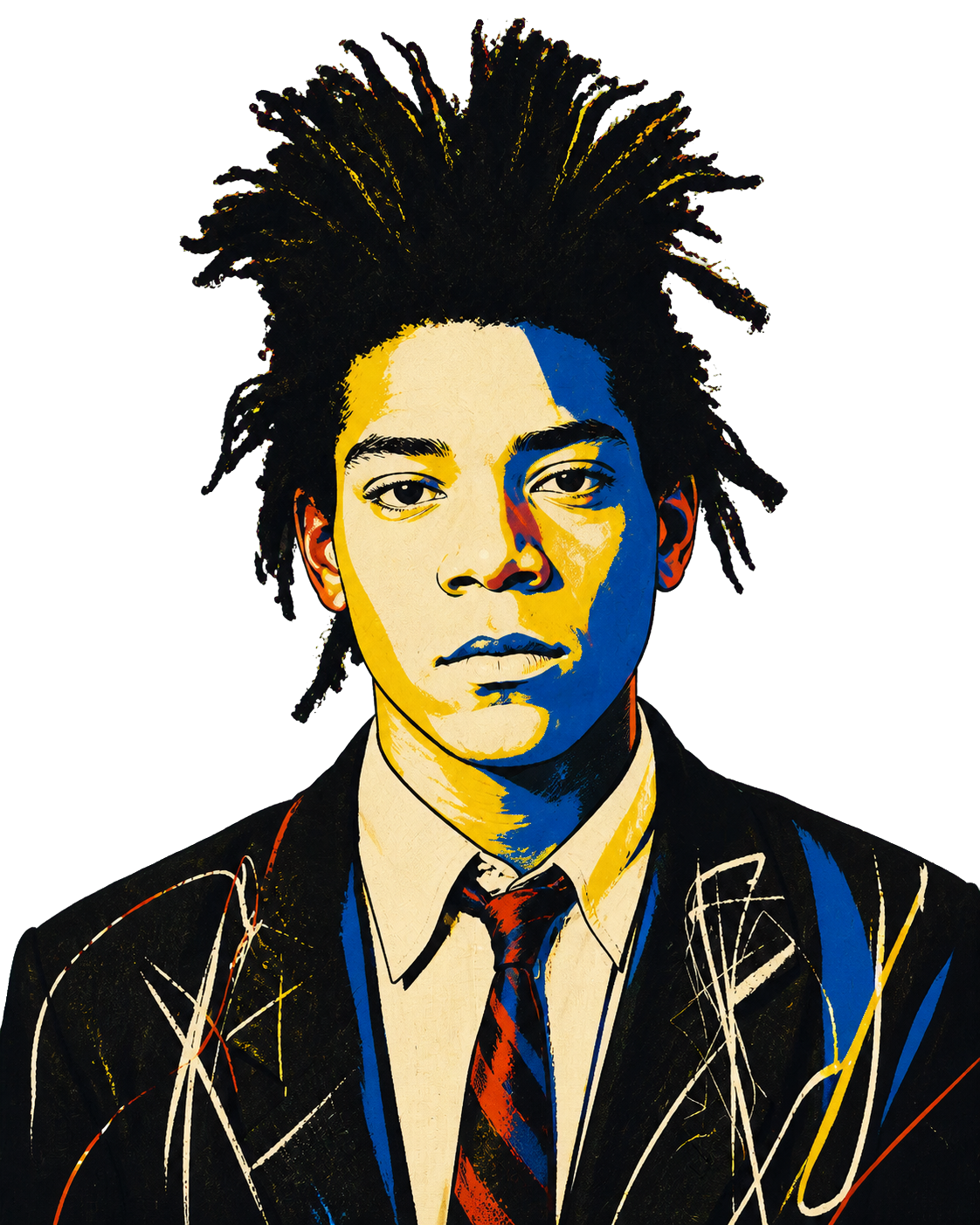
Illustrated portrait of Jean-Michel Basquiat
SAMONew YorkAnatomyCrown
00

Jean-Michel Basquiat
1960—1988

Jean-Michel Basquiat is an icon of street art, a man who reached the summit of the art world in only a few years. He was friends with Andy Warhol, dated Madonna and took part in some of the most prestigious exhibitions of his time. How did a boy from Brooklyn become an artist whose paintings are now worth hundreds of millions of dollars?

Basquiat began as a graffiti artist in New York. He worked under the name SAMO, short for “Same Old Shit.” It was a joint project with his friend Al Diaz. In the late 1970s, they covered walls in Manhattan with enigmatic aphorisms that soon attracted attention in the city’s bohemian circles. By 1980, Basquiat had turned to painting, creating canvases that combined the energy of the street, elements of primitivism and references to African American history.

The painting feels chaotic and structured at the same time.
01

FROM SAMO TO THE MUSEUM

One of Basquiat’s most forceful statements about power and racial identity is La Hara (1981). A white, skeletal figure wearing a police cap stands against an aggressive red background. The title LA HARA is written repeatedly along the left side of the canvas. In New York Puerto Rican slang, the phrase means “police officer.” The expression has been linked to the Irish surname O’Hara, which was believed to be common among New York police officers in the 1940s and 1950s. Grey bars at the bottom of the painting heighten its resemblance to a prison cell.

In the same year, Basquiat appeared in Artforum, the American magazine devoted to contemporary art. From that point onward, his work began to be taken seriously by the established art world. In 1982, he participated in Documenta 7 in Kassel, one of the most important international art events, held once every five years.

Basquiat was also invited to the Whitney Biennial, which presents the work of influential and emerging American artists. He became one of the youngest participants in the event’s history. It was during this period that he painted one of his most celebrated works.

02

UNTITLED, 1982

The canvas presents a distorted skull with an open mouth and empty eye sockets. As a child, Basquiat had been fascinated by an anatomy book. The image alludes to death, street culture and African American identity. Rough lines, intense colours and restless brushwork give the painting an atmosphere of anxiety and expression. Layers of phrases and symbols emerge from the background, a device that appears throughout Basquiat’s work. The painting feels chaotic and structured at the same time—a combination characteristic of his art.

The work was purchased for $19,000 in 1984. Over the following decades, its value increased thousands of times. In 2017, it sold at Sotheby’s for a record $110.5 million.

Another vivid example of Basquiat’s Neo-Expressionist language is Warrior, also painted in 1982. It depicts a skeletal figure holding a raised sword and a dagger. The image reflects the artist’s inner fears and anxieties, conveying a sense of concealed threat and aggression. In 2021, it sold for $41.7 million, becoming the most expensive work of Western art sold at auction in Asia at the time.

In 1985, Basquiat appeared on the cover of The New York Times Magazine—an unusual distinction for any artist, and especially for an African American artist at that moment. He quickly became one of the central figures of Neo-Expressionism. He earned millions and was invited to exhibit in prestigious galleries around the world.

A guide to looking

HOW TO RECOGNISE A JEAN-MICHEL BASQUIAT

01

SKULLS AND HEADS

They are drawn roughly, expressively and almost like caricatures. In the history of art, the skull traditionally evokes the brevity of life.

02

THE CROWN

One of Basquiat’s most recognisable signatures is a crown formed by three simple points.

03

TEXT AND CROSSINGS-OUT

His paintings contain layered inscriptions and erased words. Phrases may appear in English, Spanish or French, alongside references to historical figures.

04

STRONG COLOUR ACCENTS

Basquiat often used contrasting red, blue, yellow, black and white, reinforcing the apparent spontaneity of his technique.

05

SOCIAL AND RACIAL THEMES

His works carry pain and protest against discrimination, as well as irony toward the commercialisation of art.

03

THE KING OF PLEASURE

Basquiat was part of the New York art scene and moved among musicians, artists and wealthy collectors. In 1982, he had a brief but intense relationship with Madonna, who had not yet become a global superstar.

His behaviour often ran against accepted norms, and he consciously cultivated the image of a rebel. He would stand up and leave in the middle of an interview, draw directly on tablecloths in expensive restaurants and spend enormous sums on impulsive purchases.

Basquiat sometimes arrived at formal events without shoes. He deliberately wore wrinkled, paint-stained clothes—although the clothes themselves could be expensive. He rejected bourgeois conventions and formal behaviour as part of his effort to remain “real.”

04

RIDING WITH DEATH

Andy Warhol played a decisive role in Basquiat’s career. They met in the early 1980s, when Basquiat was already becoming known. According to one version of the story, Basquiat took the initiative: after seeing Warhol in a restaurant, he approached him and offered several of his works. Warhol was impressed, and their acquaintance soon developed into a close collaboration.

They produced paintings together, combining Basquiat’s street-inflected language with the iconic imagery of Warhol’s Pop Art. The collaborations received a mixed response. Many critics believed that Basquiat remained in Warhol’s shadow, or that the older artist was using him for commercial purposes.

Over time, their relationship became strained. Basquiat began to distance himself from Warhol and sought to prove his independence. Their friendship never fully recovered. When Warhol died unexpectedly in 1987, Basquiat fell into a deep depression.

One of Basquiat’s final works was Riding with Death. Its central figure appears to have conquered death by climbing onto its back, yet the victory feels illusory. The outcome seems inevitable.

Basquiat felt increasingly lost, and the death of a close friend and mentor accelerated his path toward self-destruction. In 1988, one year after Warhol’s death, Basquiat died from an overdose in his studio. He was twenty-seven years old.

Commission

A work made for your space

Tell us about the format, palette and atmosphere you have in mind. We will prepare a personal proposal.

Request a work in the style of Jean-Michel Basquiat

Basquiat turned the canvas into a mental wall where language, body, power and history collide without losing their rhythm.

Maestros / 01Jean-Michel Basquiat

All MaestrosBack to top ↑