
FROM THE STOCK EXCHANGE TO SYNTHETISM
The decision was daring. His wife strongly opposed it, and his friends looked on in disbelief. Even so, Gauguin took the risk.
At first he imitated the Impressionists. He soon realised that path was not his own and began searching for a more symbolic language. He found it in simple forms, dense colour and an expression freed from academic perspective.
The new approach developed by Gauguin, Émile Bernard and Louis Anquetin became known as Synthetism. While Impressionism tried to capture fleeting visual sensations, Gauguin used colour and form to express thought and emotion. The method appears with particular force in Vision After the Sermon (1888) and The Yellow Christ (1889).
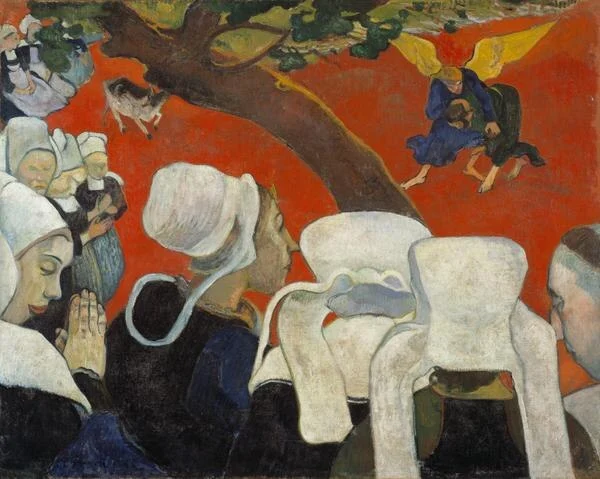
Vision After the Sermon
1888 / National Galleries of Scotland
VAN GOGH'S EAR
In 1888, Vincent van Gogh invited Gauguin to Arles. Van Gogh dreamed of creating a “Studio of the South”, a brotherhood of kindred artists. Gauguin went, but living together proved difficult. Van Gogh admired him, although their ideas about art differed profoundly.
Their constant arguments led to a conflict that culminated in the famous crisis during which Van Gogh mutilated his ear. Shaken, Gauguin left Arles. He later described that period as one of the most difficult of his life.
ESCAPE TO TAHITI: THE BIRTH OF GAUGUIN'S MATURE STYLE
Disillusioned with Europe, Gauguin travelled to Tahiti in 1891 in search of inspiration and a life free from the conventions of Western civilisation. There he found the setting in which his mature visual language took shape.
Tahitian Women on the Beach (1891) marks an early immersion in a new culture and a new palette. When Will You Marry? (1892) would later become one of the most expensive paintings ever sold.
Among his most enigmatic works is Spirit of the Dead Watching (1892). It depicts Teha’amana, Gauguin’s Tahitian companion, who was only thirteen or fourteen years old. She lies on a bed with an anxious expression while a dark figure rises behind her, the embodiment of a Tahitian spirit of death.
Yellow and violet create an uneasy atmosphere and intensify the sense of mystery and unreality. The girl’s nudity and pose suggest vulnerability before forces beyond the visible world. The painting became a landmark of Symbolism and anticipated the European avant-garde’s growing fascination with spiritual and archaic motifs.
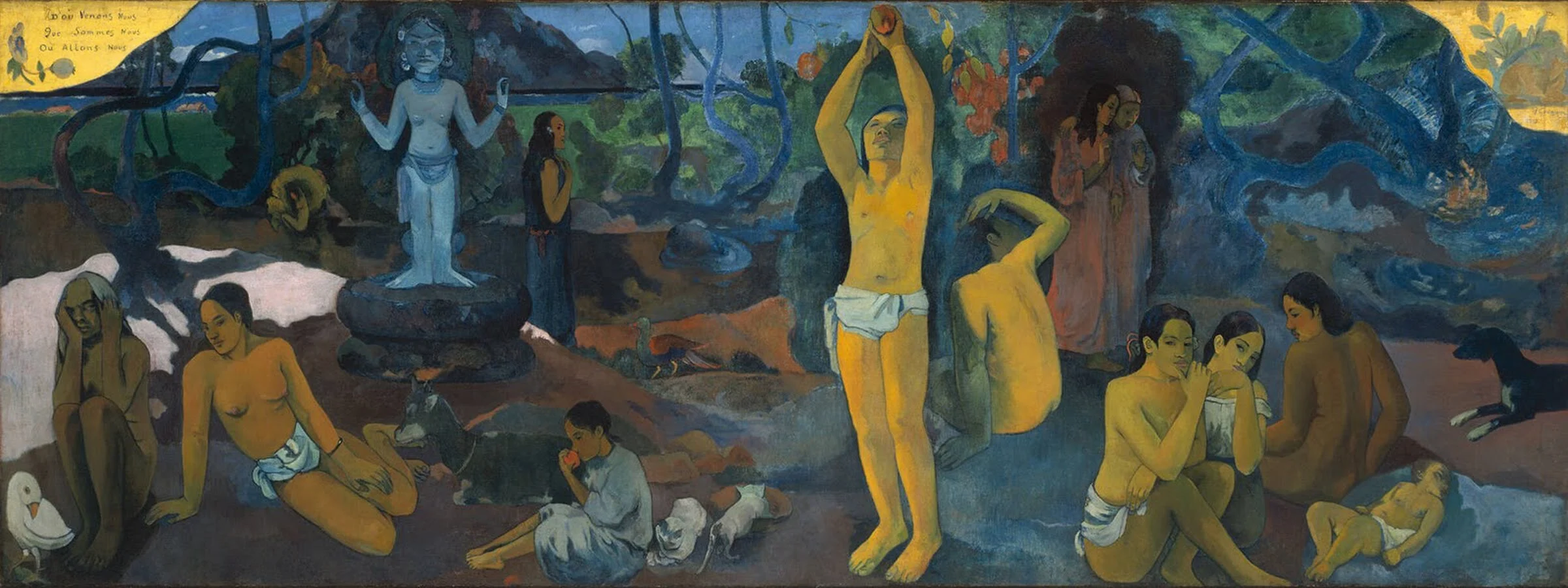
Where Do We Come From? What Are We? Where Are We Going?
1897—1898 / Museum of Fine Arts, Boston
RETURN TO PARIS
After two years in Tahiti, Gauguin returned to Europe in 1893 full of hope. He organised an exhibition of his Tahitian paintings in Paris and expected recognition. The result was disappointing. A few works sold, but critics showed little enthusiasm and described the paintings as crude and primitive.
European audiences were not ready for his intense colours, unfamiliar subjects and rejection of academic perspective. Gauguin concluded that Europe did not value his art.
His private life offered no relief either. He tried to rebuild his relationship with his wife Mette, but she rejected him. Their marriage had collapsed during the years of separation. She had endured severe financial hardship after he abandoned his career and had raised their five children almost alone while Gauguin lived as a wanderer.
Correspondence with his daughter Aline became his principal link to the family. He loved her, shared his thoughts with her and tried to preserve at least one fragile bond with his former life. Not even that bond could keep him in Europe. Two years after returning, Gauguin left for Tahiti once more.
CRISIS AND TESTAMENT
Illness was wearing Gauguin down: syphilis, heart problems and persistent pain. In 1897 he received news of Aline’s death. The loss devastated him and deepened his isolation and depression. In that state he produced some of his most philosophical and moving works: paintings about life, death and the search for meaning.
Where Do We Come From? What Are We? Where Are We Going? (1897) is Gauguin’s central philosophical statement. The image unfolds across three broad stages of human existence. On the right, a baby represents birth and the beginning of life. Adults occupy the centre and suggest maturity and the search for meaning. On the left, an old woman confronts the approach of death.
Exotic vegetation stretches over the figures. An idol in the background evokes spiritual faith and a world beyond ordinary experience.
After completing the painting, Gauguin attempted suicide by swallowing poison in the mountains. He survived. Conceived as a farewell, the work became one of the paintings that defined modern art. Gauguin regarded it as his masterpiece.
In 1901, Gauguin moved to the Marquesas Islands, farther into the Pacific and farther from everything associated with his former life. He died there at the age of fifty-four, isolated and without the recognition he had sought. His death is usually attributed to heart failure. International fame came only afterwards.