
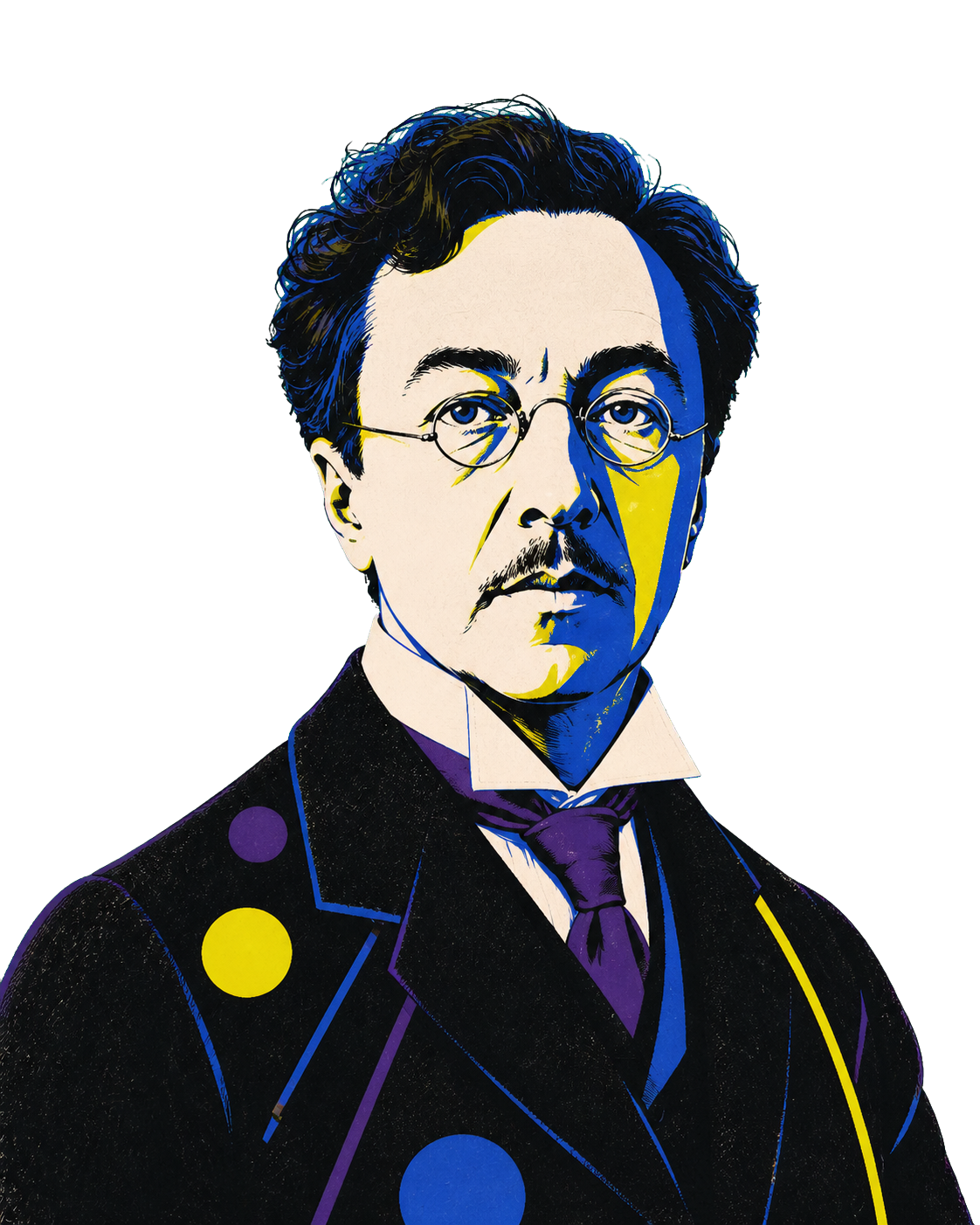
THE LAWYER WHO CHOSE PAINTING
Imagine a successful lawyer who, at the age of thirty, abandons a respected profession for paintbrushes. That is what Kandinsky did.
He was born in Moscow in 1866 and received an excellent legal education at Moscow University. He married, taught and pursued an academic career. In 1896, however, he left law behind and moved to Munich to study painting.
Kandinsky quickly became a leading figure of the avant-garde. Energetic and charismatic, he helped found the Blue Rider group with Franz Marc in 1911. His ambition was to cross the limits of traditional art and discover new forms of expression.
When the First World War began, Kandinsky was forced to leave Germany because he was a Russian citizen. In revolutionary Russia, he helped establish museums outside the major cities and worked as a teacher. Yet he became increasingly uncomfortable with the pressure of socialist ideology on art. In the early 1920s he returned to Germany and never lived in Russia again.
From 1922 to 1933, Kandinsky taught at the Bauhaus and encouraged young artists to investigate colour and form. The school transformed the appearance of the modern visual world, from architecture to typography. It developed a new approach to design based on clarity, rational structure and function. Much of what we now associate with modern minimalism would be difficult to imagine without the Bauhaus.
When the Nazis closed the school, Kandinsky had to move again. This time he settled in France, where he lived until his death in 1944. The “eternal traveller” left his mark on Russia, Germany and France: three countries and three chapters that made him an international figure and artistic innovator.
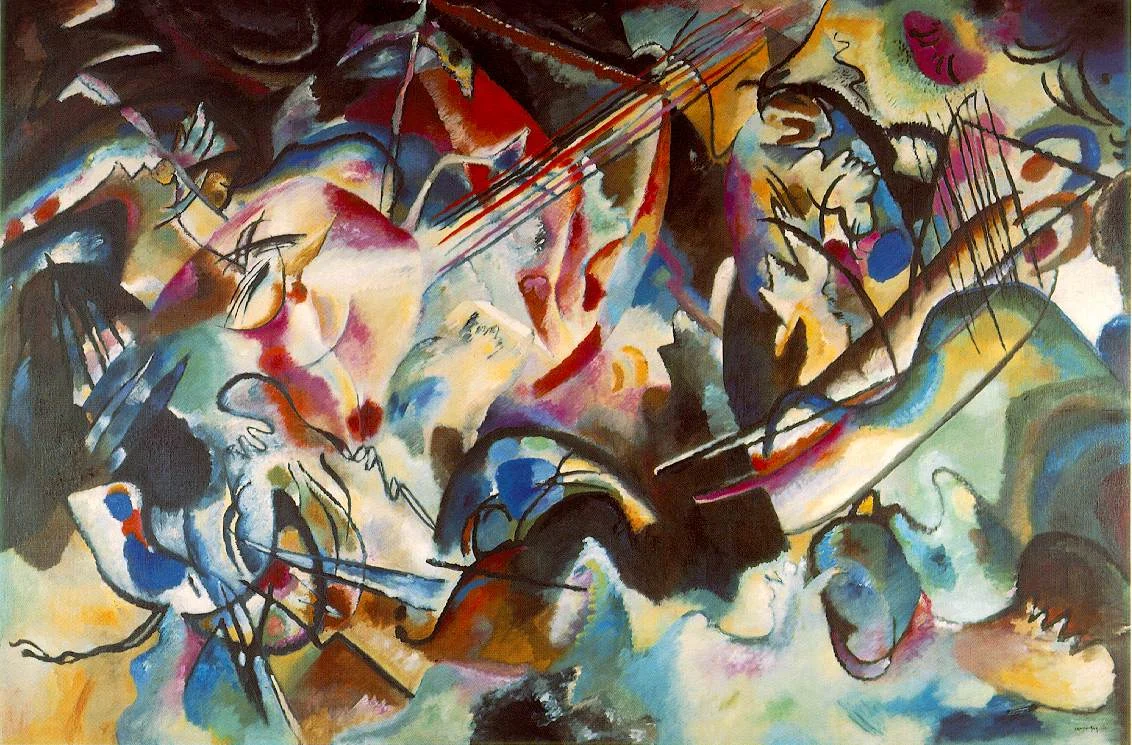
Composition VI
1913 / State Hermitage Museum
WHAT DOES THE APPARENT CHAOS MEAN?
Kandinsky believed that true art arose from the depths of the spirit. In 1911 he published Concerning the Spiritual in Art. It was not merely an essay but a programme setting out his ideas about art, the role of the artist and the spiritual nature of creation.
His central argument was that painting should not be limited to reproducing the external world. It had to express an inner, spiritual reality. If Kandinsky’s canvases appear to be chaotic collections of marks, that apparent chaos is part of his language: the language of an inner world.
In one of his most striking metaphors, the artist becomes a prophet who must pull the motionless cart of humanity forwards.
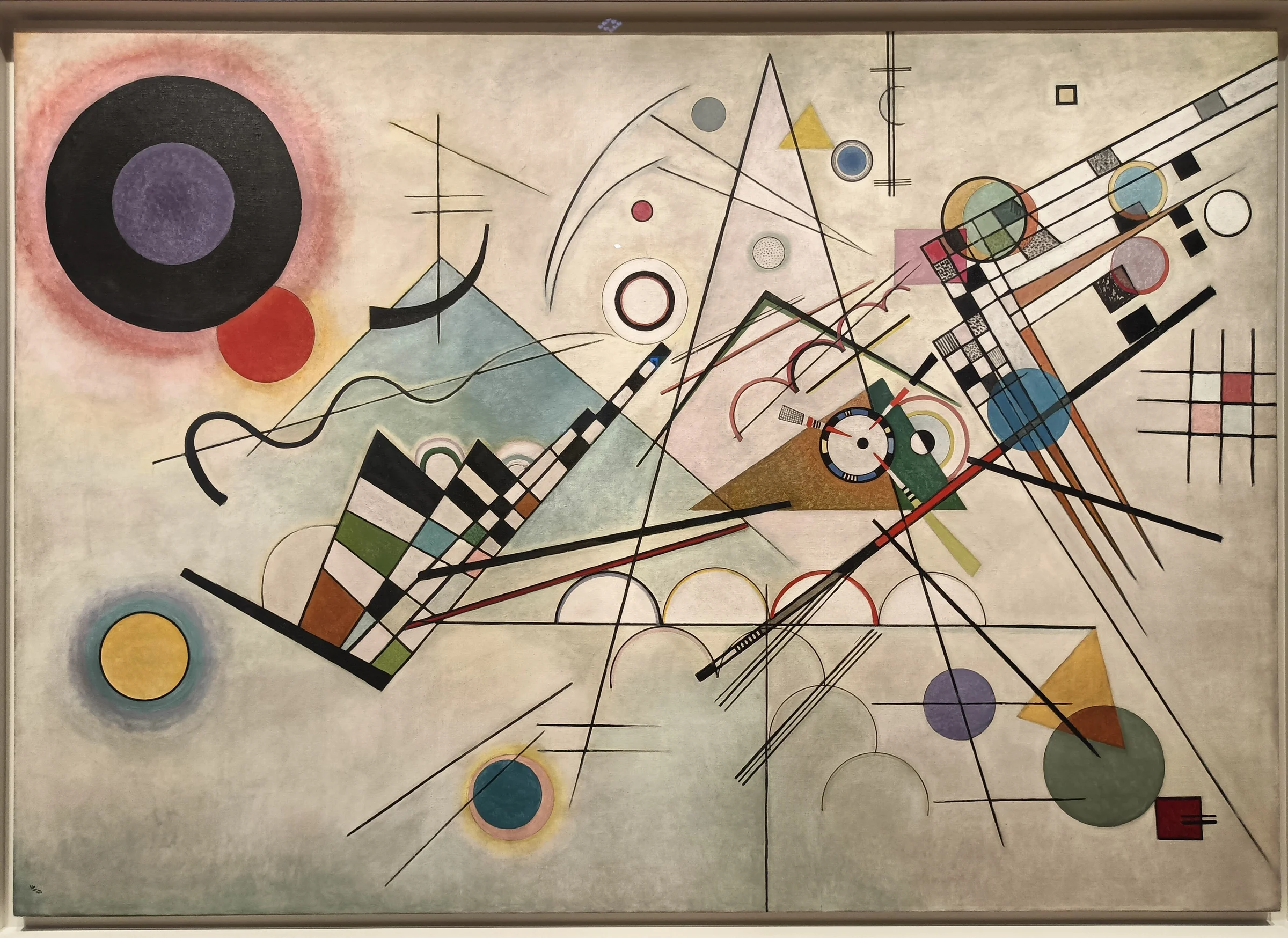
Composition VIII
1923 / Solomon R. Guggenheim Museum
SEEING COLOUR, HEARING MUSIC
Kandinsky experienced an intense connection between colour and sound. Blue could possess the depth of a cello; yellow could ring like a bell. This unusual perception allowed him to unite music and painting.
He believed colours could pluck the strings of the soul. That is why many of his works bear titles such as Improvisation or Composition, just like pieces of music.
“Colour is the keyboard, the eyes are the hammers, the soul is the piano with many strings,” Kandinsky wrote. The artist plays that instrument and sets the viewer’s inner life vibrating.
The desire to unite painting, music and spirituality became the centre of his art.
LEGACY
Kandinsky regarded Composition VIII (1923) as one of the peaks of his post-war work. Circles, triangles and lines create a visual rhythm like a musical score.
The painting was the first Kandinsky acquired by Solomon Guggenheim, who would go on to assemble more than 150 works by the artist. In time, Composition VIII became one of the emblematic images associated with that collection.
Kandinsky left an immense legacy, both as an artist and a theorist. He was one of the founders of abstract painting and one of its most influential advocates. He showed that a painting did not need to depict an object or recognisable scene in order to have meaning.
His paintings and writings opened the way for numerous twentieth-century movements. His ideas influenced teachers and students at the Bauhaus and later resonated in post-war Abstract Expressionism.
Kandinsky helped direct art towards non-figurative forms decades before they were widely accepted.