
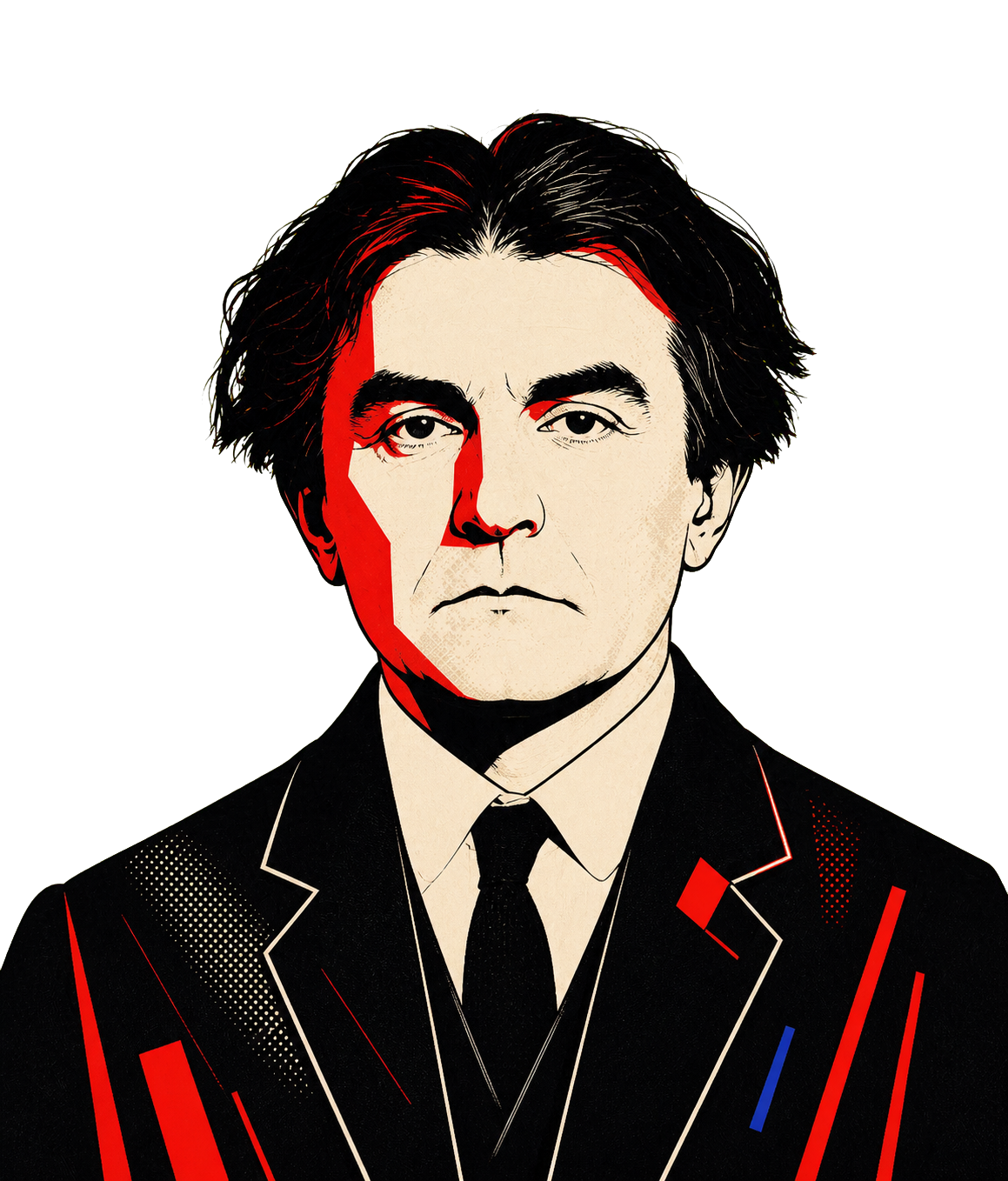
FROM OBJECT TO ZERO
He experimented with different styles and studied the work of Matisse, Picasso and Cézanne. He passed through Symbolism and Cubo-Futurism and drew inspiration from folk art. Yet he felt ever more strongly that even the boldest innovators still represented recognisable objects: figures, things and architecture.
Malevich wanted to go further. He did not wish to represent the world; he wanted to construct one of his own. ‘The object in painting was nothing more than an ornament, a beautiful tie around the neck of art,’ he wrote. In his view, art had to exist independently: not as a mirror of reality, but as a reality in itself.
The decisive turn came in 1913, when Malevich worked on the sets for the Futurist opera Victory over the Sun. In the work, the sun—a symbol of reason and tradition—vanishes from the sky. A black square first appears in his designs for the production, as a sign of extinguished light and the end of an era. It was not yet an independent painting.
In 1915, at the 0.10 exhibition in Petrograd, Malevich presented Black Square as a finished painting. He hung it in the ‘red corner’, the place reserved for an icon in traditional Russian homes. It was a powerful and precise gesture. Where a sacred face would ordinarily have appeared, there was a black square. The image had been replaced by silence.
With this act, Malevich proclaimed a new visual language. Suprematism was born, its name derived from the Latin supremus, ‘the highest’.
Could you paint a Black Square? Of course. But the decisive element is the idea. Art no longer had to communicate a story. It no longer needed objects. Form, rhythm and inner energy were enough.
It is important to understand that Black Square was not the first abstract artwork. Several years earlier, Wassily Kandinsky had created his first non-objective compositions and, in 1912, published Concerning the Spiritual in Art. Malevich, however, pushed the idea to its limit.
Kandinsky sought music and emotion within abstraction. Malevich cleared the surface until he reached an absolute zero. He rejected the Renaissance idea of the picture as a ‘window onto the world’ and made painting a world in itself.
But was Malevich really the first person to think of covering a surface in black? Formally, no. Similar experiments had already appeared. In 1883, for example, the French writer and humorist Alphonse Allais exhibited a black rectangle with a deliberately provocative comic title. It was an act of irony, a joke at the expense of academic Salon art.
Malevich turned the black square, once a joke, into a principle. He was the first to treat such a form with absolute seriousness: as a manifesto and a pictorial revelation. That is where his innovation lies.
Black Square became the centre of an entire group of Suprematist compositions shown in the same exhibition. Rectangles, circles and lines replaced everything that might resemble an object. Only form remained. Only tension.
These works are not images of something else. They simply exist. They are not representations; they are declarations.
Today, Malevich’s works belong to major collections of modern art in New York, Paris, Moscow and Saint Petersburg. In 2018, a version of Suprematist Composition sold at auction for $85.8 million. Malevich’s importance, however, cannot be measured by market value. He fundamentally changed the conception of what painting could be.
His works can often be recognised without a signature, through their style, geometry and inner tension.
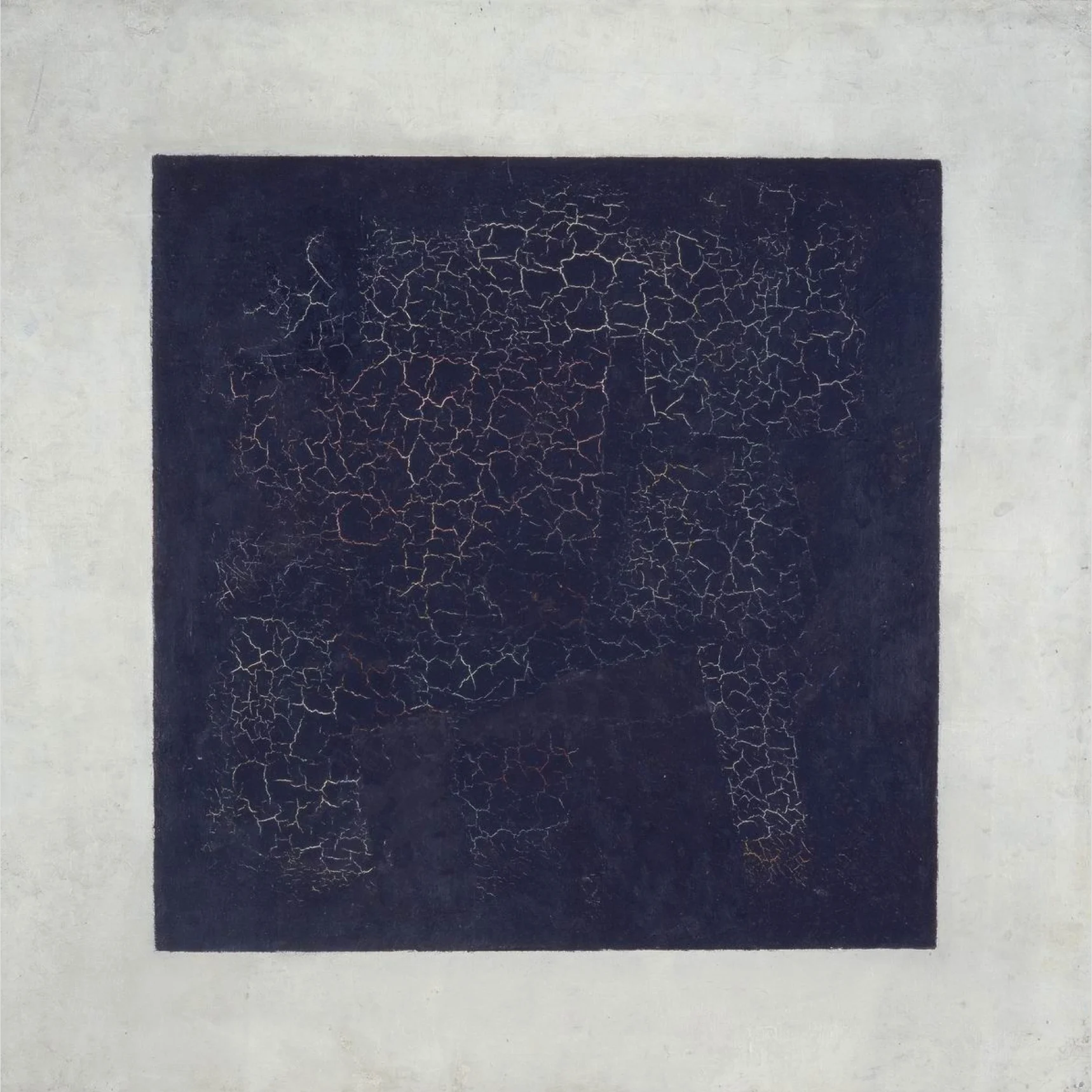
Black Square
1915 / State Tretyakov Gallery
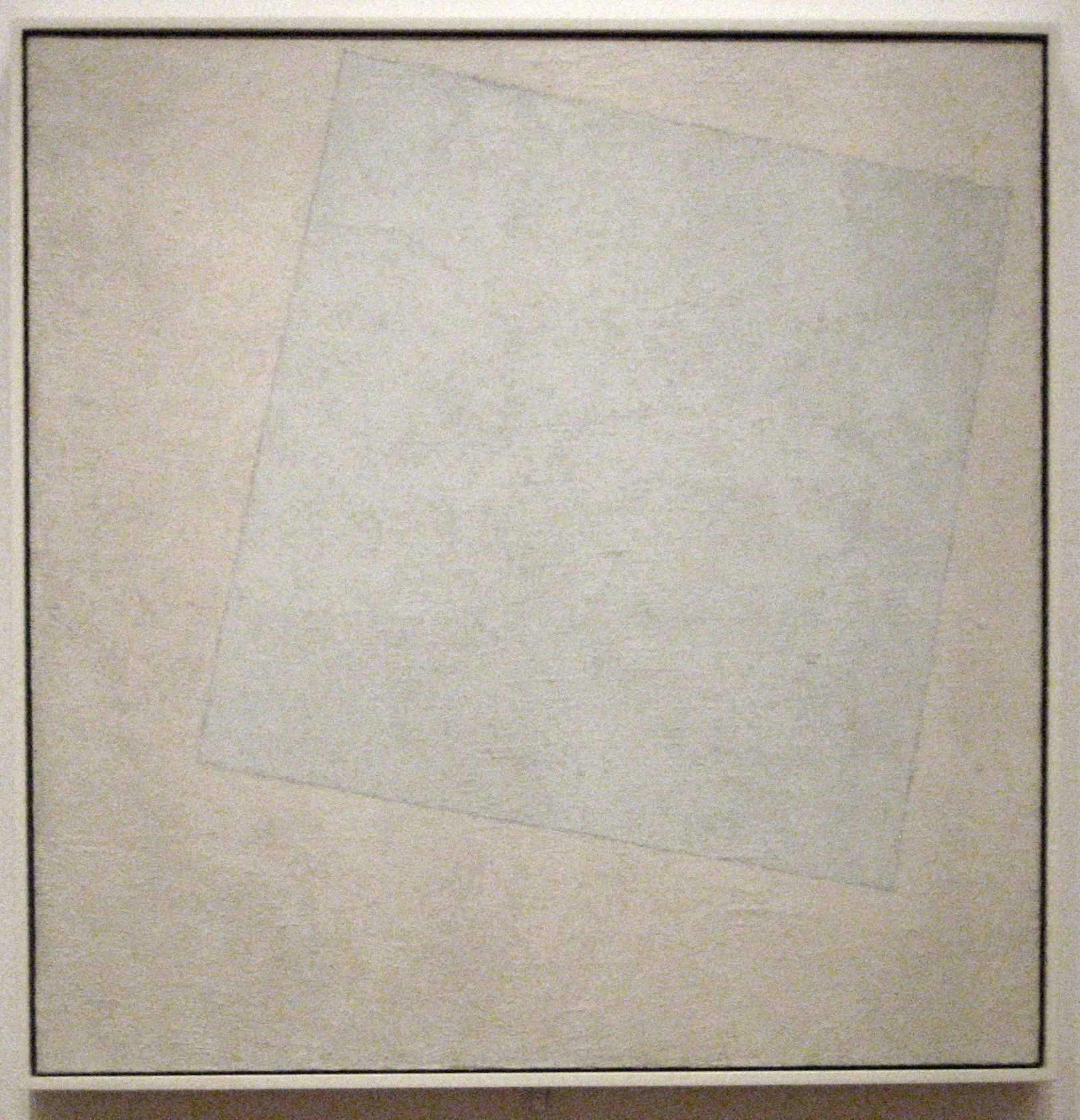
White on White
1918 / Museum of Modern Art, New York