
LEARNING IN ORDER TO DISTORT
Behind that singular language, however, lay a rigorously academic artistic education.
In 1898, Modigliani began studying at a private art studio in Livorno. In 1902 he entered the Free School of the Nude in Florence and, in 1903, continued his training at the Institute of Fine Arts in Venice. He could draw the body with anatomical accuracy and had an excellent command of technique. He drew plaster casts, painted still lifes and copied Titian. Amedeo understood the structure of the human body. He knew how to draw “correctly”, but chose to work differently.
His classical training is not only the foundation of his style but also its counterpoint. With all that knowledge behind him, his mature language represents a deliberate rejection of precision in favour of purity of form.
JOYFUL AND DOOMED
Modigliani's best-known works are steeped in deep melancholy. Elongated forms, motionless poses and almond-eyed faces without pupils give his sitters an air of introspection and distance.
Why are the eyes sometimes empty? Modigliani is said to have remarked that it was possible to paint a person's true eyes only after knowing their soul. The phrase is often repeated, although it remains one of many stories surrounded by legend and speculation.
The artist himself was not always melancholy. He was remembered as charming, witty and stimulating company. He enjoyed reciting poetry in a sing-song voice, especially Dante, and often sang. He could laugh until he cried and, five minutes later, burst into tears. Emotion overwhelmed him.
This was not merely a cultivated image. He lived with chronic pain and drank in an attempt to ease it. He laughed in order to keep living.
He worked as quickly as he felt. He often painted directly from life, rapidly and without preliminary sketches. His brushstrokes were assured, fluid and precise. In his drawings, especially those made in preparation for sculptures, he could study a form for a long time and produce dozens of variations. His spontaneity did not come from chance but from inner certainty.
MODIGLIANI IN PARIS
Modigliani arrived in Paris in 1906. At the time, the French capital was the centre of the international art world and drew young artists from everywhere. Amedeo found himself among those rethinking art at the beginning of the twentieth century.
While many artists tried to secure a place in history through manifestos and new “isms”, Modigliani seemed uninterested in belonging to a movement. He did not theorise, form circles or sign declarations. He did not become a Cubist or an Expressionist. He became himself. What mattered to him was not a programme but a gaze, a line and the person sitting before him.
La Rotonde was one of the main meeting places for painters, writers and poets. It was not merely a café but a kind of headquarters for bohemian Paris. People argued themselves hoarse, shared paintings and organised exhibitions. Modigliani was a regular visitor but, unlike the more strident theorists, he often preferred to remain silent. He listened, observed and drank. Only later would he offer his opinion.
One of his friends was Léopold Zborowski.
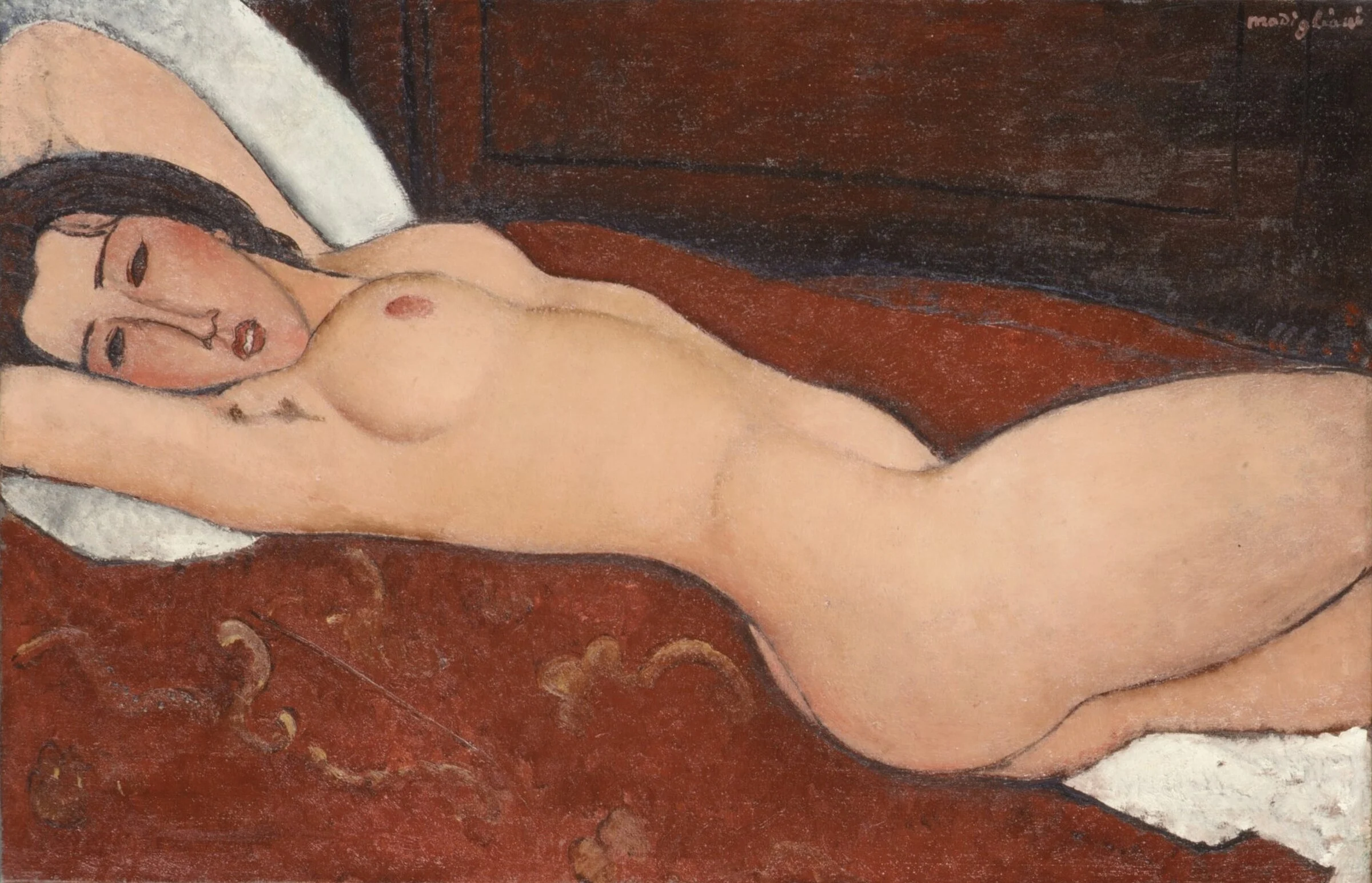
Reclining Nude
1917 / The Metropolitan Museum of Art
PORTRAIT OF LÉOPOLD ZBOROWSKI, 1916–1919
Zborowski became Modigliani's most important ally during the decisive years of his career. From 1916, he supported the artist by buying canvases for him, paying for his accommodation, helping him sell works and introducing them to collectors. He also helped Modigliani secure the studio where he produced many of his major paintings.
The portrait shows a restrained, slightly distant man dressed simply. His gaze is focused and turned just to one side. There is no theatrical pose, only precision. It is the image of someone who understood what great art demanded and stayed close while that art was being made.
WHERE DID THE STYLE COME FROM?
Modigliani developed a unique visual language by combining different influences with his personal preferences. He is often compared with Botticelli for the fluid line and elongated proportions of his figures; with Renoir for the softness and sensuality of the body; and with Gauguin for decorative colour. Modigliani gave exceptional importance to line, treating it as the primary force of the image.
African masks also had a decisive influence on his work. Their imprint can be seen in his sitters' stylised faces, elongated forms and simplified features.
In December 1917, the art dealer Berthe Weill organised Modigliani's first solo exhibition. It included a group of nudes, among them Reclining Nude. The painting is more than an image; it is a challenge. The woman's body is neither idealised nor presented through a conventional erotic fantasy. She lies calmly and looks openly at the viewer, as if indifferent to being observed.
The paintings were placed in the gallery window to attract attention. The result was disastrous. On opening day, the police ordered them removed because the naked bodies were considered too provocative for passers-by. The paintings were taken down. The critics remained silent and no buyers appeared.
Modigliani never held another solo exhibition during his lifetime. In 2015, Reclining Nude sold at Christie's for 170.4 million dollars, becoming at the time the second most expensive work ever sold at public auction.
MODIGLIANI AND JEANNE
There were many women in Modigliani's life, but Jeanne Hébuterne became his great love. She was nineteen, fourteen years younger than him. Their story could fill a novel. Jeanne was an artist from a bourgeois Catholic family, and her parents strongly opposed the relationship.
PORTRAIT OF JEANNE HÉBUTERNE, 1918
He painted her again and again, always tenderly: almond-shaped eyes, a long neck and simple clothes. The portrait contains the calm that was missing from their life together. She is not merely a lover but a muse: the light within his chaos.
Modigliani was poor, ill and dependent on alcohol. Jeanne remained devoted to him and they lived in poverty. Their daughter was born in 1918. Two years later, Jeanne was pregnant again when Amedeo was taken to hospital. They could not save him.
Modigliani died on 24 January 1920 in a hospital for the poor. He was thirty-five and in the terminal stage of tuberculous meningitis. Jeanne, then nine months pregnant, died by suicide the following day. It remains one of the most tragic stories in art history.
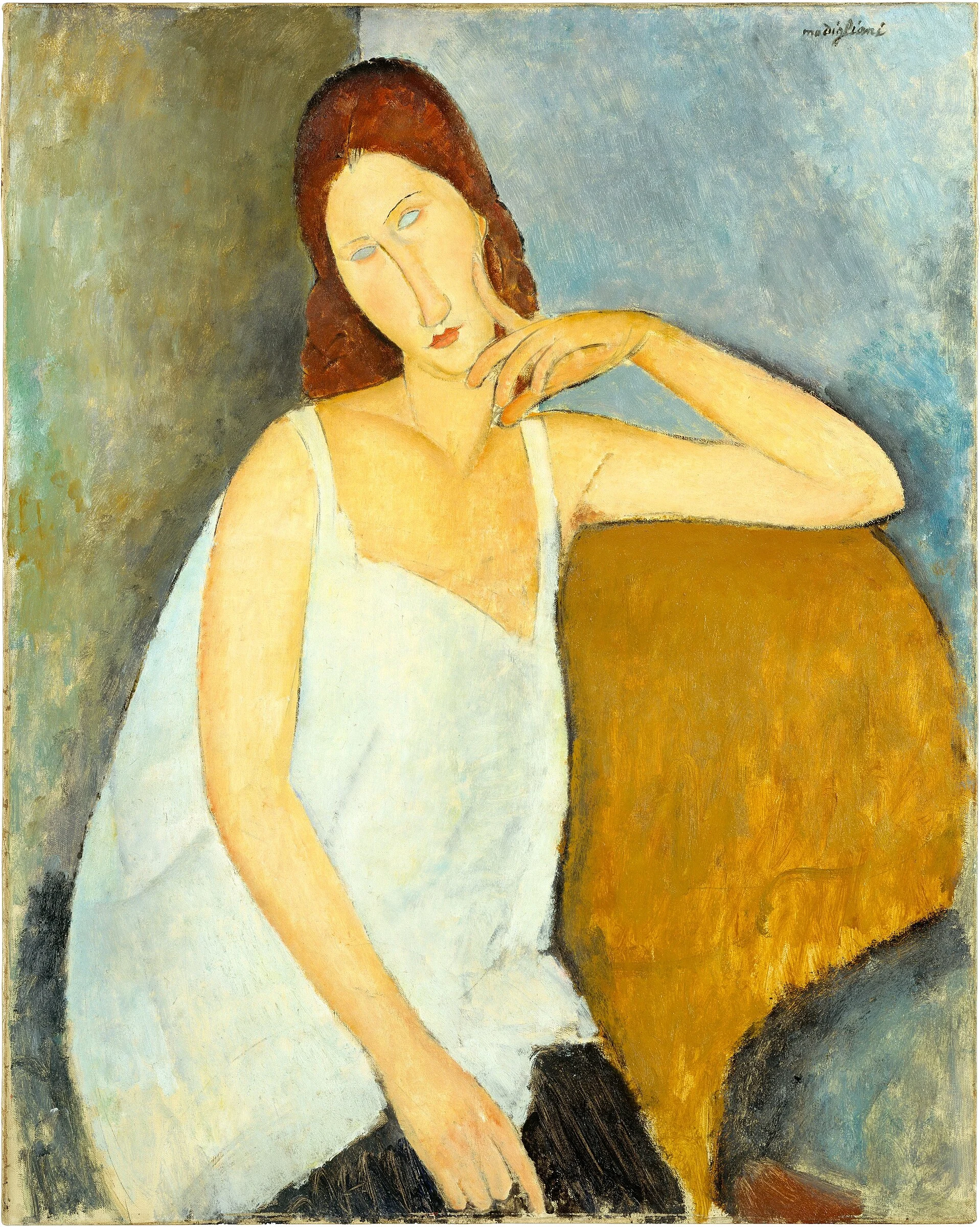
Seated Jeanne Hébuterne
1918 / Norton Simon Museum
MODIGLIANI'S LEGACY
Around 350 paintings. Several dozen sculptures. Countless forgeries. Specialists still dispute which works are authentic. Modigliani has been forged more often than many other twentieth-century artists. Why?
SIMPLIFIED, ENLARGED FORMS
His work contains relatively few details, fluid lines, limited perspective and lightly developed backgrounds. This apparent simplicity can make the style seem easy to imitate.
AN IMMEDIATELY RECOGNISABLE LANGUAGE
Modigliani sold very little during his lifetime. He kept no complete catalogue and left many works unsigned. Specialists therefore have a smaller body of securely documented material for comparison than they do for artists such as Picasso or Matisse.
NO SINGLE UNIVERSALLY ACCEPTED CATALOGUE
Several competing catalogues of his work exist, but no authoritative catalogue has been accepted by the entire international scholarly community.