
IT ALL BEGAN WITH TRAGEDY
Munch's mother died of tuberculosis when Edvard was five. His father, a military doctor, fell into depression and intense religious anguish. He withdrew from his children while warning them again and again that they were condemned to hell. Edvard suffered nightmares.
His elder sister Sophie, whom he loved deeply, took charge of the home and the other children. Nine years later, tuberculosis also claimed her life. “Illness, insanity and death were the black angels that kept watch over my cradle,” Munch would later recall.
The Sick Child (1886) is not merely a scene. It is the reworking of a traumatic memory. The pale girl and the grieving woman beside her become an altar to pain. Munch did not paint what he saw; he painted what he felt. That was his method.
From then on, almost all his works read like pages from a diary. Instead of ink, he used oil paint, charcoal and lithography. Munch also kept journals filled with dreams, panic attacks and reflections on women and death. His paintings emerged from those notes.
He was introverted, mysterious and reserved, but also tall, slender and charismatic. Women were drawn to him.
Milly Thaulow entered Munch's life suddenly and, as he would later understand it, caused him profound harm. She was a married woman from a wealthy Norwegian family and several years older than him. To Munch, Milly was forbidden and fatal. Her presence seeped into his notebooks, his letters and, eventually, his painting. Above all, she revealed the emotional abyss that can open between a man and a woman. He carried that discovery with him throughout his life.
Another relationship drove him further into art and away from lasting romantic attachments. Tulla Larsen and Munch began happily, but he soon felt trapped by her intensity. He tried to leave again and again; she tried to keep him again and again. After four years, a revolver went off during an argument and Munch lost the upper joint of the middle finger on his left hand. What happened remains unclear: no one knows who was holding the gun or whether the shot was accidental.
The incident affected him deeply. He transformed its emotional and physical consequences into paintings such as On the Operating Table (1902–1903), The Murderess (1906) and The Death of Marat I (1907).
Love affairs repeatedly shook Munch, and the subject runs throughout his work. “I cannot love,” he wrote. “I can only suffer through love.”
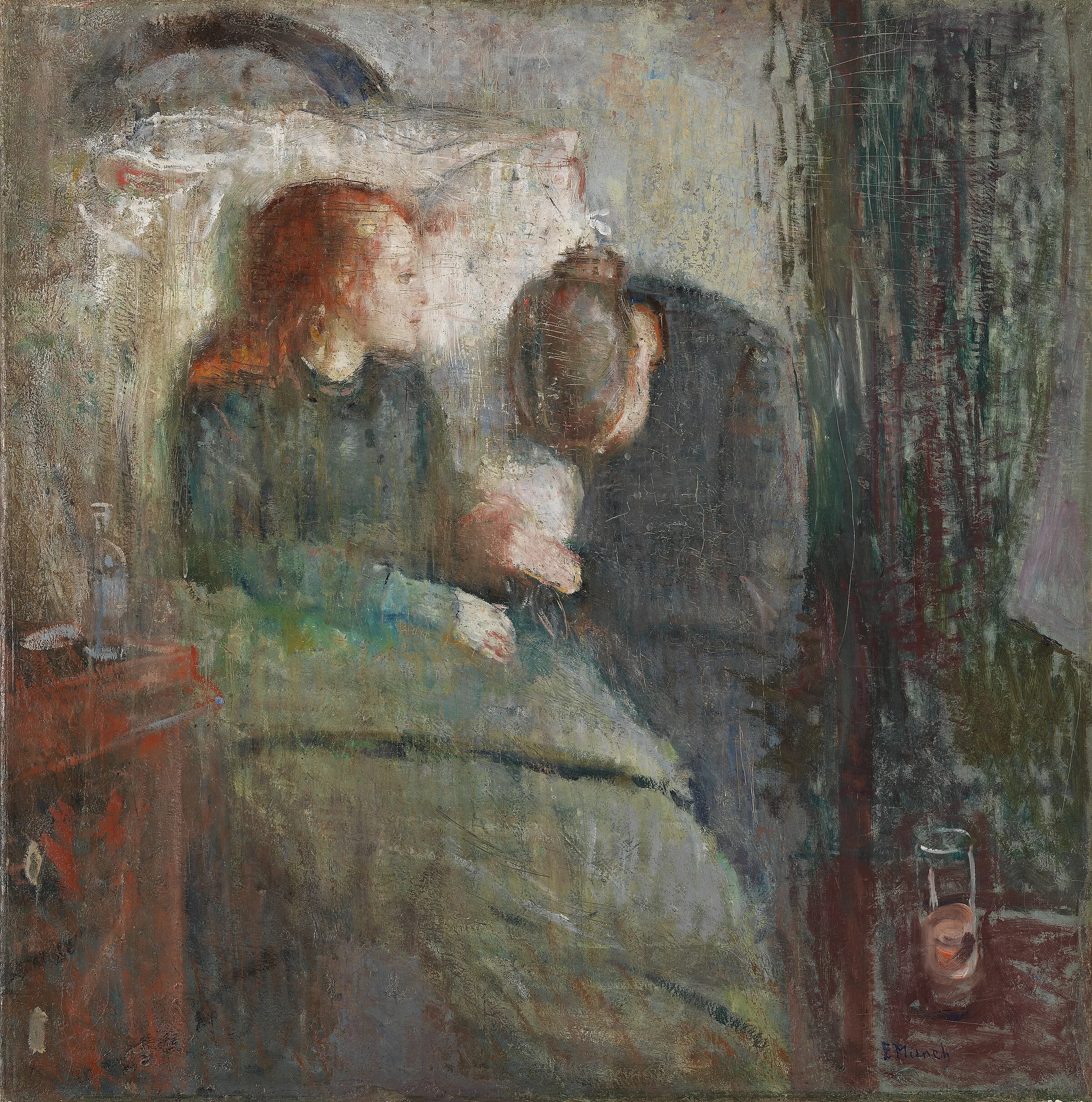
The Sick Child
1885—1886 / Nasjonalmuseet, Oslo
THE FRIEZE OF LIFE
Love. Jealousy. Fear. Loneliness. Death. Munch's great cycle begins with hope and the awakening of love, then moves towards illness, isolation and loss. It is not merely a sequence of paintings but a philosophy expressed through images. His figures are less individual portraits than archetypes.
In Vampire (1893), a woman bends over a man's neck as if drinking his blood, while his body seems to melt against her like wax. The image is not primarily erotic. It speaks of emotional exhaustion, dependence and the fear of being devoured.
In Ashes (1894), a man sits paralysed with his face covered. Beside him stands a woman whose loose red hair reaches towards him. Only the ashes at their feet remain from the fire of passion.
Then came The Scream.
In 1892, Munch was walking near Oslo when he suddenly stopped. He later wrote: “I felt an infinite scream passing through nature.” That scream became an image. Munch made several painted and graphic versions, including works in oil, pastel, tempera and lithography. One pastel version sold in 2012 for 119.9 million dollars.
Munch later turned to religious subjects. Golgotha depicts the Crucifixion but rejects its traditional treatment. Faces and bodies are elongated to intensify their emotional state. Christ appears surrounded by a crowd of distorted, grotesque figures, deepening the sense of tragedy and alienation.
The painting reflects the influence of Vincent van Gogh and Paul Gauguin, particularly their use of strong colour contrasts and the distortion of form as a means of expressing inner experience.
In 1908, Munch suffered a severe psychological crisis marked by alcoholism, paranoia, hallucinations and fear. He entered a psychiatric clinic near Copenhagen. After treatment, his palette became brighter, although the emotional tension never disappeared.
He moved to the outskirts of Oslo and lived in seclusion. Housekeepers and relatives irritated him; he preferred solitude. The walls of his home were covered with his own paintings.
He began depicting labour, nature and portraits, yet the same anxiety and vulnerability remained. In Self-Portrait with Skeleton Arm (1895), he looks directly at the viewer as if asking: are you afraid of being alive too?
Munch did far more than paint; he experimented constantly. He combined techniques, tested materials and sought unfamiliar textures. At times he placed his paintings outdoors and left them exposed to rain, snow and sunlight, allowing nature to “finish” the surface. The method had consequences: unstable conditions caused deterioration and corrosion in some works, creating serious conservation challenges.
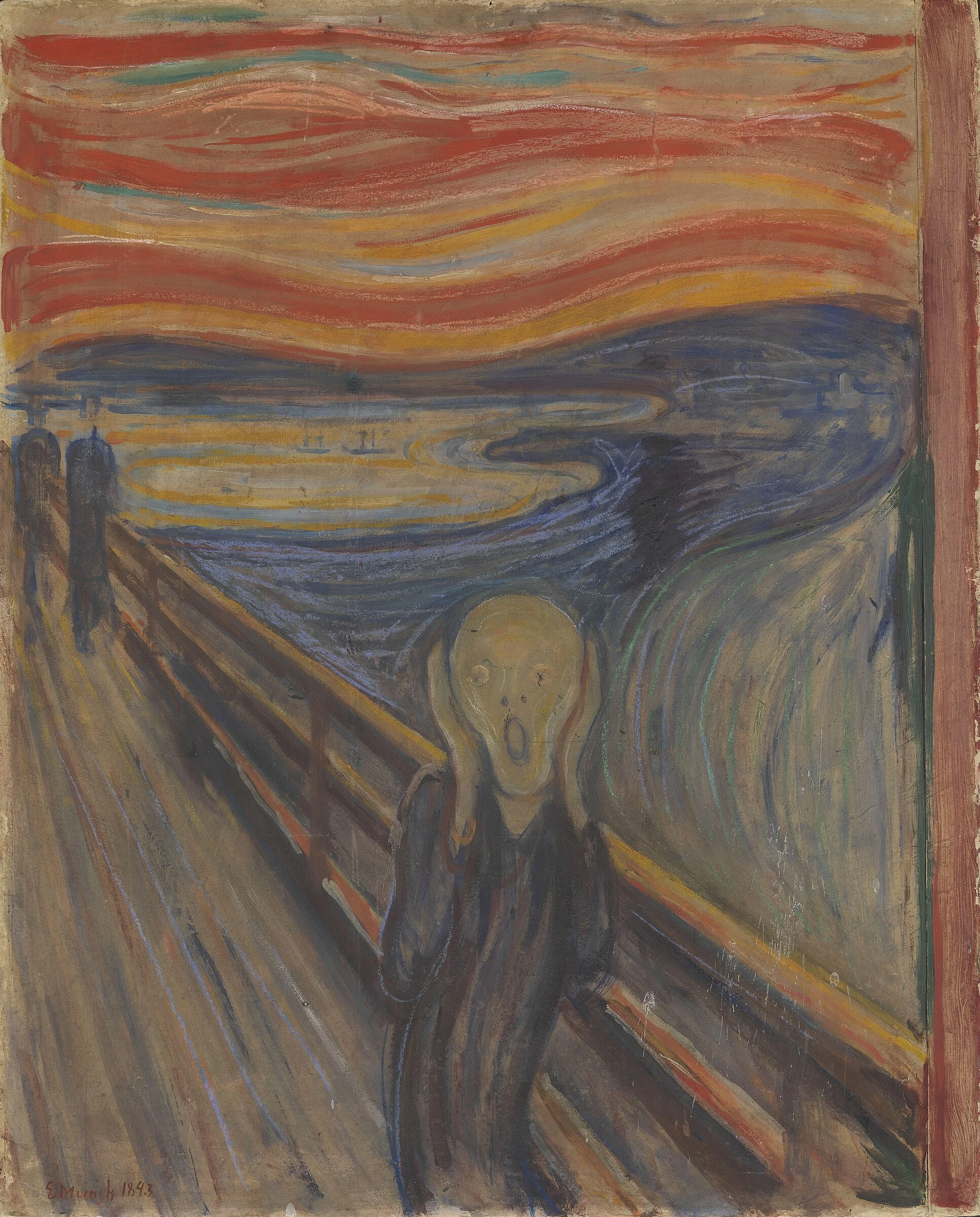
The Scream
1893 / Nasjonalmuseet, Oslo