
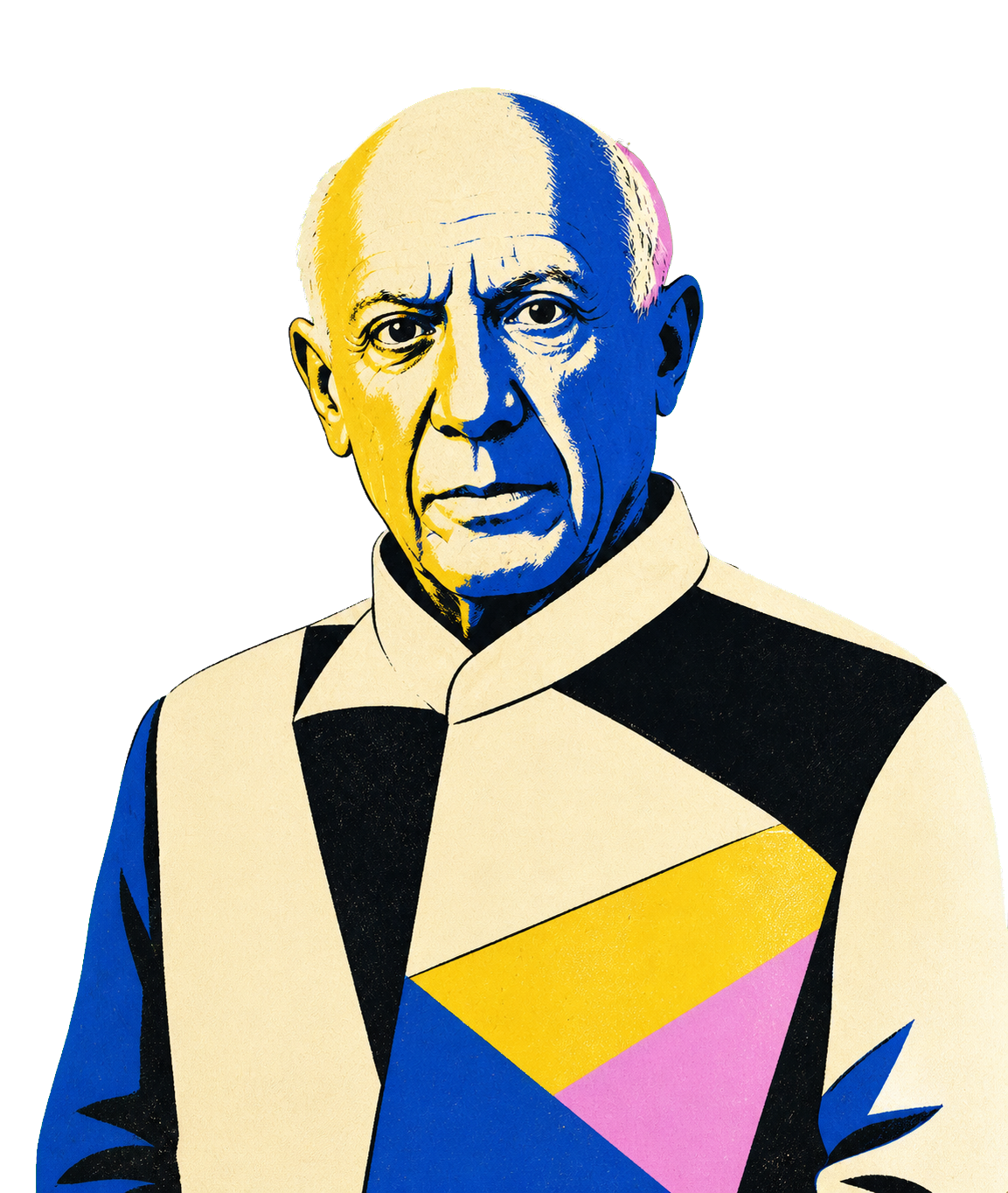
LEARNING TO DRAW LIKE A CHILD
Who has not looked at a Picasso and thought, “A child could do that”? Perhaps a child could produce something superficially similar.
But these works cannot be judged only in terms of technical skill or realism. The ideas, context, philosophy and visual language matter. Attempting to draw “the same way” does not mean thinking the same way or participating in the artistic breakthrough that made the image possible.
Picasso once looked at children’s drawings and said: “When I was their age, I could draw like Raphael. It took me a lifetime to learn to draw like a child.”
He had indeed mastered drawing while still a teenager. Picasso received a traditional academic education and studied at the Royal Academy of Fine Arts in Madrid. Why, then, did he later produce images that some viewers dismiss as scribbles?
Picasso was an artist of his century, and the twentieth century brought a genuine revolution in art. Artists rejected traditional forms and methods. Realism, academic convention and imitation were no longer enough. They searched for new means of expression, creating dozens of avant-garde movements—from Expressionism to Pop Art, Futurism to Minimalism.
Picasso became one of the architects of that revolution. He helped invent Cubism, moved freely between different directions and was afraid of almost nothing.
DRAWING ON NAPKINS
Picasso never stopped working. “Inspiration exists, but it has to find you working,” he said. Painting, drawing, sculpture and ceramics occupied him constantly. His studio was crowded with canvases, and he could begin several works at once. He experimented, broke traditions and rebuilt the language of art.
He drew on anything available: napkins, wallpaper and newspapers. In Paris, where he spent much of his life, his studio became a meeting place for artists, poets and philosophers. Ideas that changed twentieth-century art were formed within those walls.
Picasso knew Salvador Dalí and Ernest Hemingway. He was close to Guillaume Apollinaire, the poet who supported Cubism and wrote about it. Apollinaire was among the first to understand that Picasso was not simply a painter but a phenomenon. Their friendship was sustained by intellectual conversation and artistic experiment.
Georges Braque was another decisive figure in his life. Together, Braque and Picasso developed Cubism, a radical method that changed the understanding of painting. They dismantled traditional perspective and showed that an image could present several viewpoints and layers at once.
During the 1940s, Picasso mixed with Jean-Paul Sartre and Simone de Beauvoir. He was interested in their philosophical ideas, in Existentialism and in questions of freedom. Although he disliked giving exact definitions of his own work, he absorbed the thinking of intellectuals around him and transformed it through art.
His relationship with Henri Matisse was particularly important. They were rivals more than friends, but they respected one another. Matisse called Picasso “a devourer of everything new,” while Picasso admired Matisse’s discoveries in colour. Their creative competition pushed both artists toward new forms and solutions.
A WILD CHARACTER
Picasso was a difficult man. Friends described him as hot-tempered, emotional and sometimes despotic. He was completely convinced of his genius and expected others to recognise it. He could not tolerate criticism and was capable of harshness and even cruelty toward those closest to him.
At the same time, he possessed extraordinary charm. He could tell stories for hours, joke and draw others into his ideas. He loved long conversations about politics, art and life. He worked through the night, forgetting food and sleep. He accepted rules neither in art nor in life.
ICONIC PAINTINGS
Picasso produced around 20,000 works. Several became enduring symbols of his genius.
LES DEMOISELLES D’AVIGNON, 1907
This painting was revolutionary. Inspired by African masks and so-called “primitive” art, Picasso constructed five female figures with sharp, angular faces and deformed bodies. The work is often treated as a point of departure for Cubism.
It shocked contemporary viewers. Traditional perspective disappears, while the women’s bodies appear to have been broken into fragments and assembled again.
GUERNICA, 1937
Guernica is one of the most famous anti-war paintings in history. Picasso created it in response to the Luftwaffe bombing of the Basque town during the Spanish Civil War. The enormous black-and-white canvas is filled with screaming figures, distorted faces and broken bodies. It communicates the horror of war and became a manifesto against violence.
According to a famous story, a German officer saw a reproduction of Guernica during the Second World War and asked Picasso, “Did you do this?” The artist replied, “No. You did.”
PORTRAIT OF DORA MAAR, 1937
Dora Maar was one of the most important women in Picasso’s life. Painted in a Cubist language, the portrait presents her face as though it had been shattered. One side conveys weariness and pain; the other, tension and force. The work reflects their difficult relationship—passion, jealousy and a struggle between powerful personalities.
WOMEN
Picasso’s private life was intense and turbulent. His relationships often began as passionate love stories and ended in scandal, pain and psychological abuse.
His first major muse was Fernande Olivier. She was followed by the Russian ballerina Olga Khokhlova, who became his first wife. Their marriage collapsed after Picasso began a relationship with the seventeen-year-old Marie-Thérèse Walter, although he and Olga remained legally married until her death in 1955.
The photographer and artist Dora Maar later entered his life, followed by the painter Françoise Gilot—the only woman who chose to leave him. Jacqueline Roque became his companion during his final years and remained with him until the end.
Each of these women left a trace in his art. Their faces, personalities and emotions appear throughout his paintings. Picasso did not merely depict them; he transformed love, desire, anger and conflict into images.