
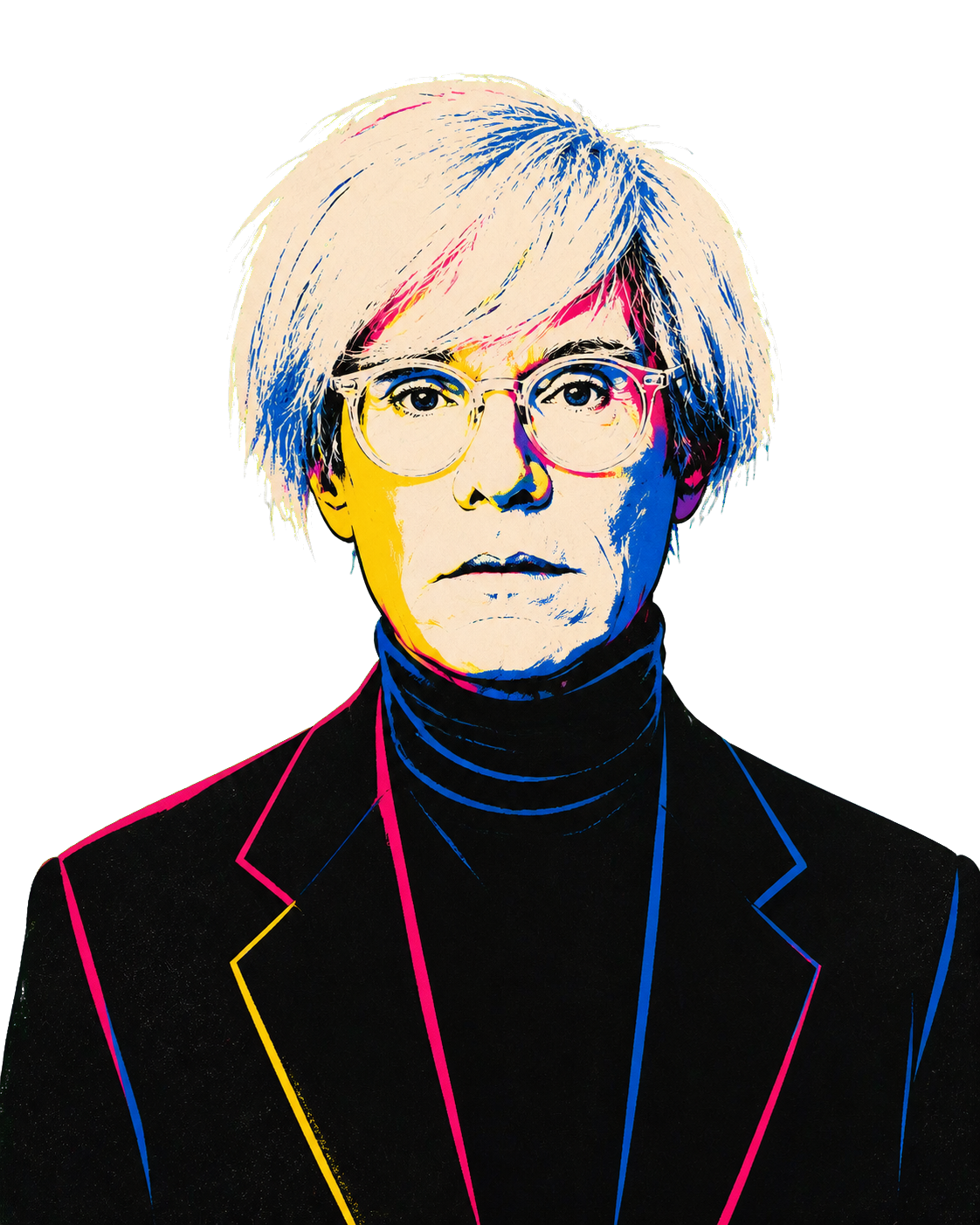
BECOMING A BRAND
His talent was noticed quickly. He created illustrations for fashion magazines, designed advertising and produced record covers. But this was not enough. Warhol did not want to remain behind other people’s brands. He wanted to become a brand himself.
POP ART: ART FROM THE SUPERMARKET
In 1962, Warhol exhibited his first paintings of Campbell’s soup cans. Thirty-two canvases presented the apparent monotony of consumer life. What could be more ordinary? That was precisely Warhol’s insight. He transformed mass culture into art.
For centuries, painters had depicted gods, kings and revolutions. Warhol decided that the new gods were Marilyn Monroe, Elvis Presley, soup cans and dollar bills. He took everyday images and made them iconic.
Marilyn Diptych (1962) is among his most famous works. Monroe’s portrait is divided into two zones: bright and radiant on the left, faded and sombre on the right. The contrast sets the manufactured image of a star against the tragedy of her fate.
THE FACTORY: A BOHEMIAN CLUB AND ARTIFICIAL PARADISE
In the mid-1960s, Warhol established the Factory, a studio that became a centre of the New York underground. Artists, musicians, models and millionaires met on the fifth floor of 231 East 47th Street in Manhattan. The Factory produced images in quantity. Paintings were made and avant-garde films were shot within the same walls.
Warhol became more than an artist; he became a brand. He wore a wig, spoke in riddles and cultivated an aura of mystery. He understood the power of media and used it deliberately. People wanted access to his life. In that sense, he was one of the first artist-influencers.
THE SHOOTING THAT CHANGED EVERYTHING
On 3 June 1968, an attempt was made on Warhol’s life. Valerie Solanas, a radical feminist and acquaintance of the artist, had written a play and hoped that he would produce it. Warhol considered the text too vulgar, and the manuscript was subsequently lost at his studio. Solanas became convinced that he intended to steal her work. She began making threatening calls, and eventually Warhol stopped answering.
That day, Solanas came to Warhol’s office. She entered a lift with Warhol, his manager Fred Hughes and the critic Mario Amaya. She drew a gun and fired several times. One shot missed; another grazed Warhol; a third passed through his abdomen and damaged multiple organs.
Solanas then wounded Amaya and attempted to shoot Hughes, but the weapon failed. She fled and later surrendered to the police.
Warhol was declared clinically dead at the hospital, but a five-hour operation saved him. He spent two months recovering and underwent repeated procedures. For the rest of his life, he wore a surgical corset.
The attack changed him. He became more guarded and withdrawn and restricted access to his circle. The shift also affected his work.
DEATH AS PART OF POP ART
In the early 1960s, Warhol began his Death and Disaster series. If the soup cans and celebrity portraits recorded the imagery of mass culture, these works insisted that death was equally embedded in everyday media.
Electric Chair became one of the series’ defining images. Warhol took a press photograph of an empty execution chamber and converted it into a cold, silent symbol of state death. The image has often been associated with the execution of Julius and Ethel Rosenberg, who had been convicted of espionage.
Warhol stripped the scene of overt emotion. Death became mechanical and strangely routine—a media fact converted into a repeatable image.
LIFE AS ART, ART AS BUSINESS
Warhol never pretended to be embarrassed by money. He turned it into a subject and a principle. Before him, many artists publicly distanced themselves from commerce and remained attached to the idea of art as elevated and disinterested. Warhol declared that art was business.
His works were not always unique objects. He reproduced them intentionally, creating a recognisable brand comparable with a commercial logo. The strategy seems familiar today, but in the 1960s it challenged the values of the art world.
During the 1970s, Warhol produced commissioned portraits for wealthy clients while releasing hundreds of screenprints. Art became a production line. Other artists accused him of cynicism, while critics called him a commercial opportunist. Yet this approach helped make Warhol a superstar. In 2022, Shot Sage Blue Marilyn sold for $195 million.
From 1974 onward, Warhol also filled cardboard boxes with material from daily life—letters, receipts, newspaper clippings and objects from the studio. More than six hundred of these “time capsules” survive, each a miniature record of New York life during the period.